

Did you see the campaign film by Vattenfal about growing seaweed (sea kelp) at offshore wind farms which they call ‘wind farming’? It stars ‘… iconic actor and social justice advocate Samuel L. Jackson, who isn’t afraid to tell it like it is’ (Fig. 1). Of course, he is just a paid actor who sold his credibility when he praised great odds in a commercial for Bet365.com (the world’s biggest online sports betting company). Vattenfall claims that the actor is not just a great actor, however, but also someone with a passion for marine life who once studied marine biology and excited to challenge people’s thoughts about wind farms. Samuel L. Jackson should know then that seaweed accumulates contaminants like trace metals from their environment which can risk human health if consumed.
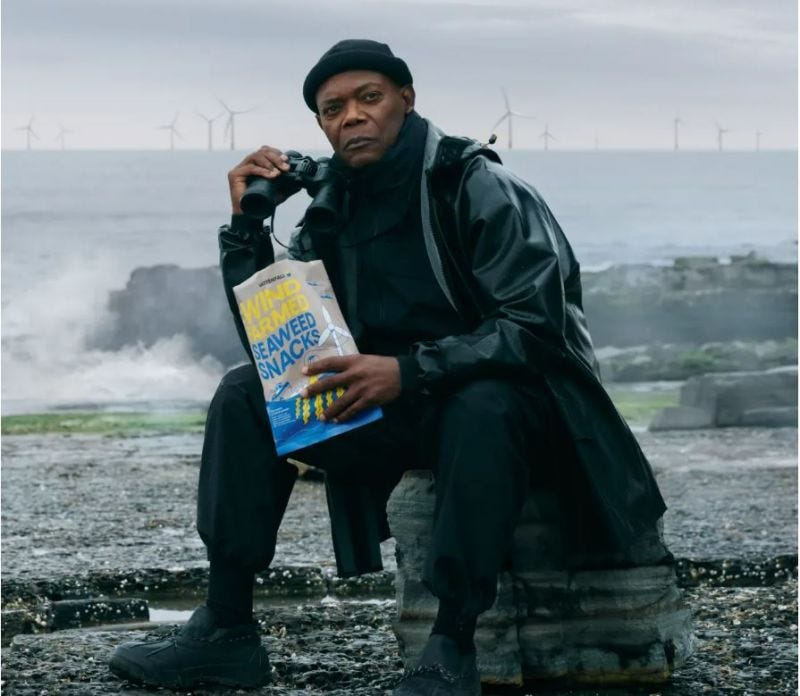
Figure 1. An actor holding a bag of wind farmed seaweed snacks in a commercial for Vattenfall.
Toxins are persistently released by offshore wind turbines both above and below the sea surface. A study of available scientific literature shows that offshore wind farms possibly emit over 200 contaminants into the environment, with coatings accounting for the majority of substances, followed by anti corrosion systems on the metal, and oil and grease for operation. The underwater zone of an offshore wind turbine needs protection from metal corrosion (rusting). Corrosion-protection systems used to protect turbines from rusting can release metals into the ocean over time. Metal inputs released from operational offshore wind farms and their ecotoxicological risks are under assessed and not evaluated in the environmental impact assessment of an offshore wind farm. This is probably because this is a new area of research. Watson et al. (2025) estimate annual inputs of metals from current European wind farms to be substantial and increasing 12 times by 2050. They advise against co-locating aquaculture with offshore wind farms without taking measurements to prevent metals discharge in surrounding water, accumulating in kelp and the tissues of oysters and mussels. While artificial reef effects and the sanctuary inside for fish from fisheries are often mentioned as positive side effects of offshore wind farms, this research warns for the health risks to those higher up the food chain. Fish residing inside or near an offshore wind farm may be adversely affected, and oysters and mussels grown there may pose a risk to human health. Watson et al. (2025) offer solutions to address these issues, but Vattenfall does not explain which steps they take to mitigate these health risks. Vattenfall doesn’t sell the wind farmed seaweed snack, it is a marketing prop (Fig. 1).
As a surfer I must ask myself, what does wind farming do to surfing waves that reach the coast1? According to a Lindhardt et al. (2024), natural sea kelp forests reduce the short waves of a passing swell during low tide when there is more sea kelp floating near the sea surface. This means shorter waves (less than 5 s wave period) are removed while the longer swell waves that we like to surf roll through. For an excellent explanation see this newsletter by Science of Surfing Kevin Okun. It may be that the kelp in wind farming, attached to ropes hung from the wind turbines near the sea surface, ‘cleans up’ incoming surfing waves. The research was done in a natural kelp forest in Point Loma, Southern California, where incoming swell waves have travelled great distances in the Pacific Ocean. But what about locations where surfers must put up with surfing the short-wave chop, for example in the North Sea? Waves whipped up by North Sea storms usually have shorter wave periods while the longer North Atlantic swells are largely blocked (Fig. 2).
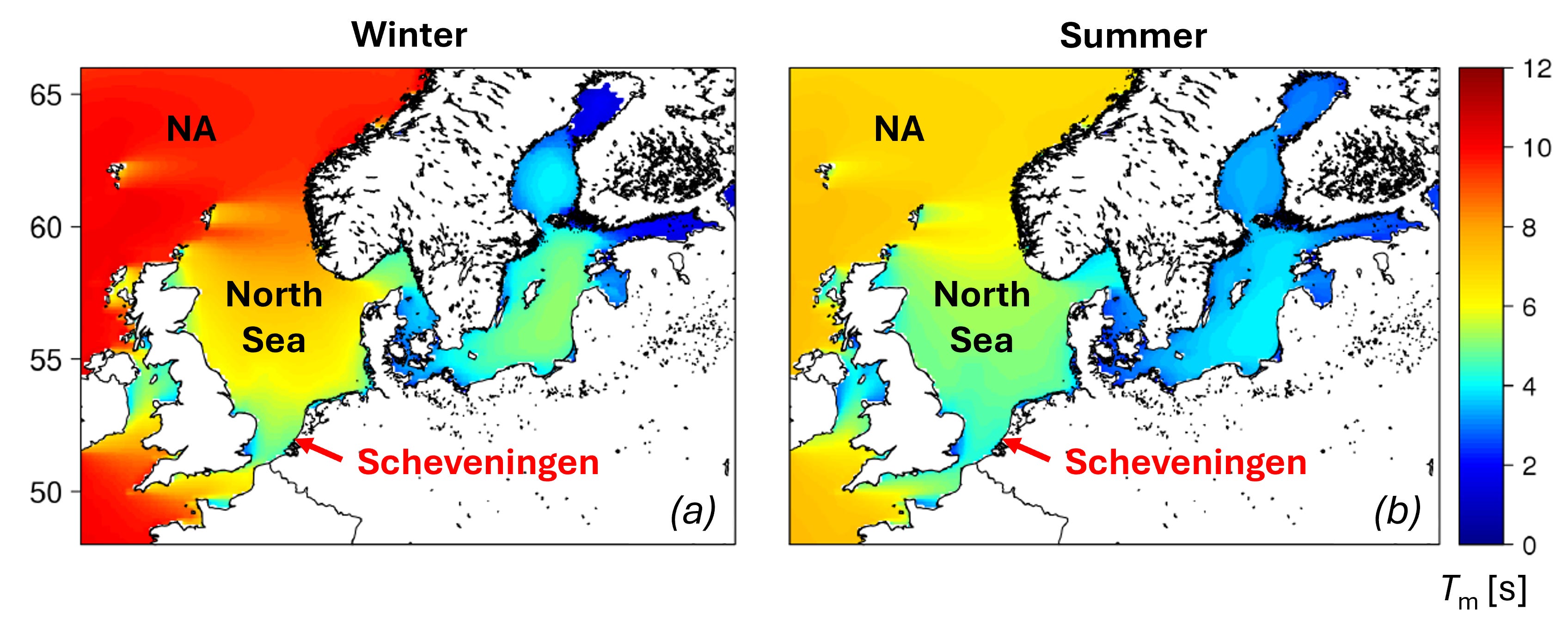
Figure 2. Average mean wave period, Tm (s), using ERA5-hindcast (1980–2005) during (a) winter (December to February), and (b) summer (June to August); NA indicates North Atlantic (adopted from Bonaduce et al. (2019))
Outside Scheveningen (Fig. 2), the surfing capital of the Netherlands, a commercial-scale seaweed farm will be integrated into an offshore windfarm in the North Sea owned by Vattenfall and BASF. Let’s hope the kelp is not so dense that the local surfers will lose what little they have. My husband brought up another consequence of farming sea kelp. He grew up surfing Point Loma and was the King of Pescadero (which I like to think makes me the Queen of Pescadero). After the wild kelp outside Point Loma was commercially harvested or after big storms, large chunks of it would be left loose in the ocean and wash ashore. The kelp in the waves made surfing very difficult. One day his nine-year-old brother found a swimfin buried in the seaweed and a dead body attached to it. It looked like a body surfer got tangled up in the seaweed and drowned; he had lain undiscovered for several days. Let’s hope Vattenfall will make sure their seaweed will be kept away from the beaches.
I will address the question if offshore wind farms can change surfing waves by themselves in a future Sealetter.
Surfing waves are a combination of wind waves and swell waves. Wind waves are generated locally and have a short wavelength and waveperiod. Another term for short wind waves is chop and they make the waves messy. Swell waves are generated by a distant storm and travel long distances before they hit the coast. While traveling they organize themselves in long lined-up waves with long wavelength and -period, which surfers describe in the absence of short waves as clean or glassy. Most surfers prefer clean waves.
Great commentary and observations, Lonneke. Seems like "wind farming" is akin to "bull shitting". Inspired by Vattenfall, we'll soon be launching a line of snacks called Endangered Species Crisps