
A Planning Process Under Strain
What I witnessed at the Banniskirk Substation hearing

This Sealetter describes my experience attending the meeting of the Highland Council’s North Planning Applications Committee on Wednesday, 26 November 2025. The agenda is packed, but I am here for the Pre-Determination Hearing and Determination of the Planning Application for the Banniskirk Substation (item 6). The applicant is SSEN Transmission.
I am interested because the development is part of the wider plan to transmit electricity from future offshore wind farms in the north of Scotland to south of the border, where the power is said to be needed.
What follows is not a detailed report of the meeting, but my personal observations. You can watch the full webcast of the meeting here; it should remain available for a year.
An early start
Kathrin picks me up at 5:45 to drive to the Highland Council headquarters in Inverness. It is still pitch dark, but we are lucky that there is no snow or ice on the road today. Seven days ago, when I came back from Inverness by bus, conditions were very different: cars struggled to get uphill, and I saw one vehicle turned upside down in a ditch near Watten.
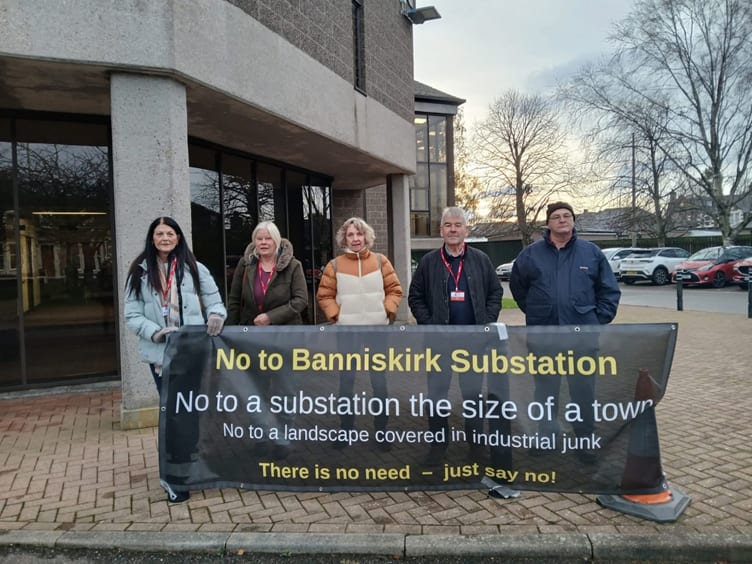
It is a long drive - at least 100 miles on the A9. We arrive in one piece and meet other objectors at the headquarters. We hang a banner reading “No to Banniskirk Substation” inside the building but are told to remove it because it is considered “political.” Fine; we hang it outside near the entrance instead, which is better anyway because more people can see it (Fig. 1).
Councillor Matthew Reiss is asked to leave the meeting
The meeting, scheduled to start at 9:30, is delayed by technical issues. It finally begins around 10:00 with a roll call. I sit behind Kathrin with other objectors; more are gathered at the back.
Cllr Matthew Reiss, sitting in the public gallery, is asked by the Highland Council solicitor to leave because his presence could “say something.” Reiss has recently been forced to resign from the North Highland planning committee after suggesting in the media that there should be a pause on renewable energy projects. He leaves the chamber but continues to follow the meeting online from outside. I assume they cannot ban him from the building.
Cllr John Edmondson asks why Reiss cannot sit in this PUBLIC meeting. The solicitor replies vaguely that her advice is “legally privileged.” Cllr. Reiss’ absence speaks a thousand time louder than his presence.
Conflicts of interest
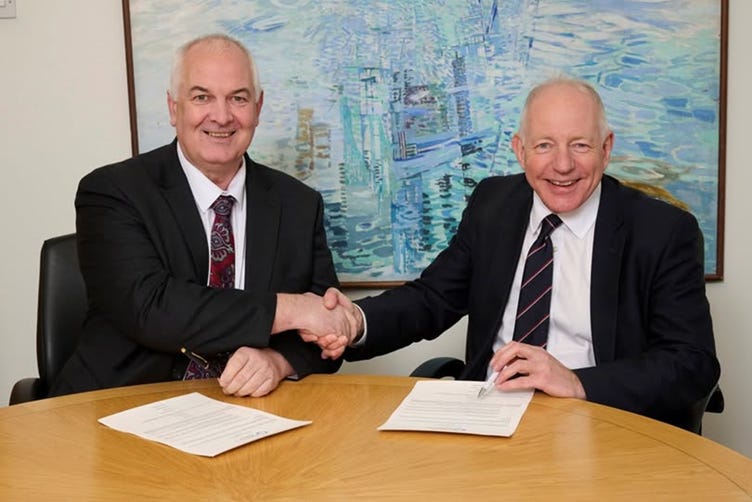
Councillors declare any conflicts of interest on items in the agenda. I expect the Leader of the Highland Council, Cllr Bremner, to declare one because just yesterday he cosigned the Highland Social Value Charter with SSEN Transmission. This is no secret, there is even a newspaper photo of him in a suit shaking hands with a suit of SSEN (Fig. 2).
But today, dressed in drab leisurewear, he declares no conflict (webcast, 0:03:22). He insists that cosigning the charter does not express any view or support for any planning proposal. He touches his nose1. The solicitor has no privileged advice to offer this time.
Case Officer and SSEN present their case
The Case Officer gives a PowerPoint presentation on the planning application (webcast, 0:12:46). He explains the need for the Banniskirk Substation, which will connect future offshore wind farms in the north of Scotland, including the dreaded West of Orkney Wind Farm and Ayre Floating Wind Farm, to the grid. The Banniskirk substation will extend half a kilometre along the A9, with buildings 15 metres high.
Fly-throughs of the proposed development are shown. He comments that “if a tourist drives past on the A9, they will only see it for a minute.” But what about the people who live there and will see it for the rest of their lives? On construction traffic, a major concern on single-track Highland roads, he claims tourists “don’t mind being slowed down because they are on holiday.” Again: what about locals who must get to work, take children to school, or reach A&E in an emergency?
A spokesperson for SSEN then reads out reasons why the application should be granted (webcast, 1:10:50). He sounds bored and so am I, until he mentions a projected 10% biodiversity net gain. He asserts that a “structured methodology shows measurable biodiversity improvements in the long-term ownership,” while touching his nose twice. He shuffles his pages but offers no further details; those will come only once legal agreements are in place.
Objectors
Then it is the objectors’ turn (slides here). First is Kathrin, representing the Halkirk Community Council (webcast, 1:45:10). She dismantles the claimed need for the substation and, unlike the applicant, provides actual numbers from SSEN and NESO:
Current generation capacity in North Scotland: 9 GW
Peak demand in Scotland: 4 GW
SSEN’s ambition for North Scotland: 50 GW
Increase to connection capacity in Spittal with Banniskirk Hub: 12 GW
She also highlights that this year alone, £1.3 billion of consumer money was wasted due to over-generation.
Next is neighbour Catherine, whose moving presentation resembles a victim impact statement (webcast, 1:55:57). Some homes lie only metres from the boundary, yet not all appear on the applicant’s maps. The consented West of Orkney substation and the planned Ayre Offshore Wind Farm substation are also very close (Fig. 3).
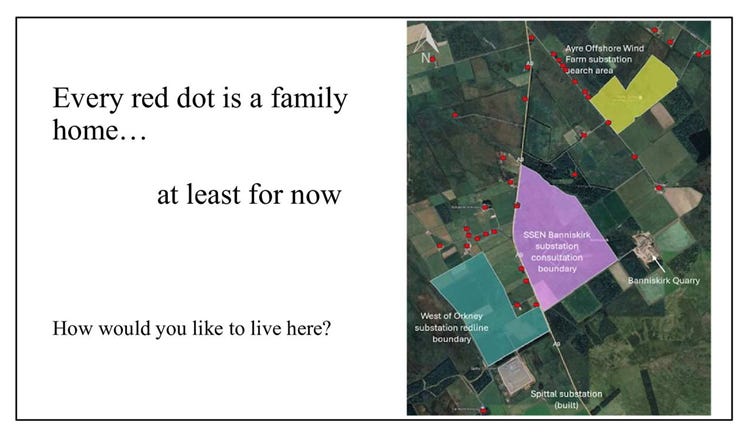
Catherine comments on the slide shown in Figure 3:
“Every red dot is a family home … at least for now. Some of the houses are not mentioned in the lists of the application. But we know all these people. This was a close-knit community with many families helping each other out, many of whom have lived here for decades. Since SSE started making plans for this area the community has been ripped apart. We lost close friends, and it killed our community spirit. The impact on mental health has been horrendous for everyone, and we are all scared of what the future brings. And please, just for scale, take a look at the size of the existing substation highlighted at the bottom of the picture. It is tiny in comparison. How would you like to live here?”
She says many people in her community want to leave but house sales consistently fall through. Martin Godwin of SSEN told her they would not buy a house in the area because they wouldn’t be able to sell after completion. I wouldn’t want to live there for free.
Her presentation hits hard. The applicant is asked to respond, and I am tormented by listening to their non-responses (webcast, 2:14:14).
Question time
Councillors ask questions. One asks how large the site is compared to Halkirk, or in football pitches. The SSEN representative replies, “I haven’t done the maths.” He appears to try calculating on the spot but fails. (It is 140 football pitches.)
Cllr Richard Gale points out that the application includes no information about the use of the gas SF6 in the electrical switchgear. SF6 is a greenhouse gas 24,300 times more potent than CO₂, with an atmospheric lifetime of around 3,200 years. He also raises concerns about the effects of electromagnetic radiation (EM) on bees and other insects.
Cllr Edmondson notes that the Memorandum of Understanding (MoU) on biodiversity was not provided to councillors. The solicitor says she “can provide that now,” but of course it is too late for proper scrutiny. Who knows. The MoU may include a compensatory wildflower meadow on a strategic site somewhere in the Highland Council area (though good luck finding a spot free from EM exposure if all SSEN projects go ahead). Let me help: once construction is complete, the species richness inside Banniskirk Substation will be essentially one - the occasional human checking the site.
Debate and decision
We break for lunch at 13:30 and resume at 14:00. Cllr Margaret Paterson says locals should be compensated for the loss of property value. “No,” says the solicitor. “Depreciation is not a material planning consideration.” A site visit is proposed to allow councillors to appreciate the real impact on the community, but the Chair sees no need. There is no time anyway; they must decide within a week. I lose interest and look forward to the voting, the fundamental process in a democratic society. Who is going to vote for, and who is going to vote against? Several councillors have expressed serious concerns, so I feel some hope.
But there is no vote. Instead, the councillors somehow agree that the application will be approved, subject to strict conditions. The justification is that if the Council objects, the application will go to the Scottish Government and the Council will “lose control,” as Cllr Bremner has stressed earlier (webcast, 3:28:50). Unfortunately, as I understand it, the applicant is responsible for monitoring these conditions themselves, as the council does not have the capacity to do so.
If this is true, then democracy is dead.
Hard lessons learned
Most objectors leave, but Kathrin stays for the remaining renewable-energy items on the agenda. I walk into Inverness to unwind. The meeting does not end until 6 p.m., and then we drive the treacherous 100 miles home in the dark again. Many councillors also face long round trips to go to these meetings, and now they must return on Friday because they could not finish today’s agenda. The Council is overwhelmed by the sheer volume of applications for wind farms, solar farms, battery farms, substations, pylons, and related infrastructure. It is clear they cannot cope.
I am deeply sad for the “resident receptors” whose lives have been upended, for the objectors who worked so hard, and for the councillors doing their best but seemingly powerless. I am almost sad for those representing SSEN today, for selling their souls. Almost. But I am far sadder for the man I met today who will have to give up his horse-riding school next to Banniskirk Substation because horses are sensitive animals. It is going to be a miserable Christmas and an even worse New Year for people like him.
I learn that I have been naïve in believing the Government exists to serve its voters. I hope the story does not end here. A Freedom of Information request has been submitted regarding the circumstances in which Matthew Reiss was “told or advised” to leave the planning meeting. To be continued …
A lot of people have no idea what is going on and even less of what is coming. There is so much deception going on.
A grueling and frustrating day for you and your well-informed colleagues, Lonneke. We're also plagued by pro-wind nose-touchers on this side of the Atlantic.